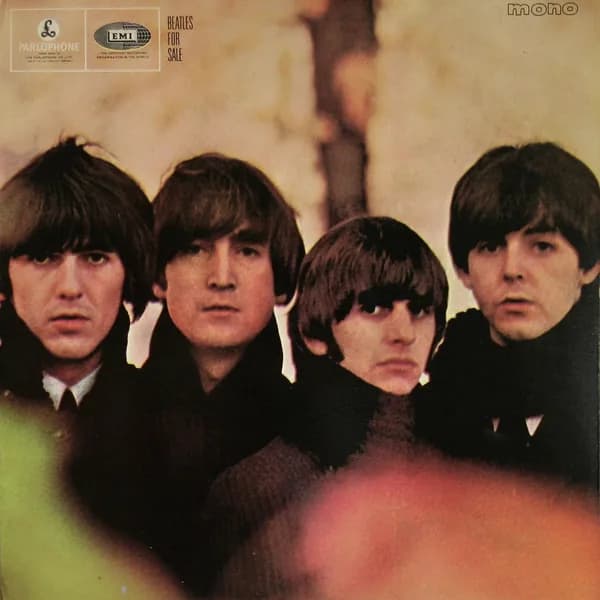
Kansas City / Hey-Hey-Hey-Hey!
“Gonna get my baby back home”
What is unique about this song?
Of all the Beatles' records, it is one of the nine songs in a medley. It also was cut as a first take, and it has George Martin playing on it as well as producing. It is the Beatles' single recording of a Jerry Leiber and Mike Stoller song.
What happened around it?
see full timeline →'I'll Follow the Sun' and 'Rock and Roll Music' were cut at the same session. Most of Beatles For Sale went down in one session, and this song was part of it. On the day of the session, feedback was used on a pop record for the first time, on 'I Feel Fine', recorded at Abbey Road.
● hover for more info● tap a tag for its page and notes
Text168 tags
Travel is one of its subjects (Journey to retrieve partner), along with the motifs of relationship and americanism, one of 23 across the catalogue, 1965 being the year for it. The lyric turns to pastiche (faithful 1950s rock-and-roll cover), which this song is the first to do. An extrametrical rhyme arrives once, "Woo now girl / you". For anyone keeping count, the title is written with an exclamation mark and has carried two titles. Worth a footnote, the line "Five six seven eight nine" turns up in one other Beatles song, 'All Together Now'.
Cover-shared words
Cover-shared shape
affiliate link - supports this wiki
Music124 tags
'Kansas City / Hey-Hey-Hey-Hey!' is a rock and roll and R&B song in G major, around 131 BPM, and it owes something to blues. The tune carries call and response, one voice asking and the rest answering (lead vs backing in chorus/outro), which also turns up in 'Baby It's You', a year earlier. Listen to a lead vocal at full power (Little Richard-style screaming vocal) and yeah vocals. Underneath it is a plain 12-bar blues, the shape behind 32 of the Beatles' recordings, such as 'Little Child' and 'Chains'. A curiosity, the harmony moves G7 → C7 → G → D7 → C7 → G, the same shape 'Revolution' takes as B7 → E7 → B7 → F♯7 → E7 → B.
Chord shape
affiliate link - supports this wiki
Studio11 tags
This track came out of EMI Studio 2, recorded in a single take during the marathon October 18 session, with George Martin overdubbing piano afterwards. Lennon played the Rickenbacker 325 on it, his guitar. It is taken out on a fade-out, one of 46 across the catalogue, 1967 being the year for it. Six songs were recorded the day this one was, the 63rd to the 68th of their career.
affiliate link - supports this wiki
People11 tags
Jerry Leiber, Mike Stoller and Little Richard wrote it, and McCartney sings lead. George Martin played piano, as he also did on 'You Like Me Too Much' and 'A Hard Day's Night'.
affiliate link - supports this wiki
Info20 tags
The track was never released as a single, arriving instead with Beatles For Sale, December 4, 1964. America got it six months later, on Beatles VI, put out by Capitol. This song was the 28th of the 35 records they released in that year, and the 62nd counting from the start.
affiliate link - supports this wiki
Sources & references
Tags on this page are original analysis, transcribed and cross-checked against the fine work of others: Alan W. Pollack's “Notes on…” series, the Beatles Complete Scores (Hal Leonard), Mark Lewisohn's session histories, Ian MacDonald's Revolution in the Head, Dave Rybaczewski's Beatles Music History and Andy Babiuk's Beatles Gear for the instruments and studio equipment, and others besides - then verified by ear against the recordings. Full bibliography: Sources & thanks.
External entity links: MusicBrainz recording · MusicBrainz work
Updated
Feedback
Got a tag idea for Kansas City / Hey-Hey-Hey-Hey!? Or think we've got it all wrong - no, no, no? Don't let it be.