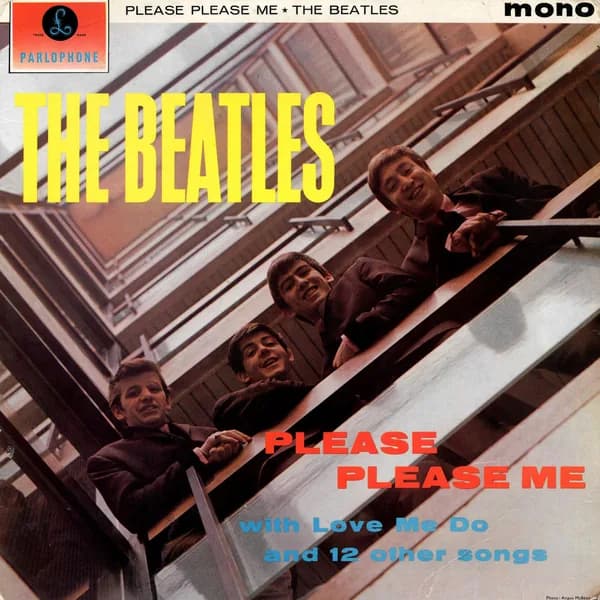
Please Please Me
“Last night I said these words to my girl”
What is unique about this song?
This one is one of two songs that show the mark of Roy Orbison, 'Day Tripper' being the second, and one of two songs that were recorded with a Hohner Echo Vamper, with 'From Me to You' for company. This is where the Rickenbacker 325 first turns up on a Beatles record, with 43 more to follow, such as 'Chains' and 'Twist and Shout'.
What happened around it?
see full timeline →Three months into the making of Please Please Me, the same day's work produced 'Ask Me Why'.
The Childhood motif first appears in the Beatles catalogue on 'Please Please Me' (1963).
● hover for more info● tap a tag for its page and notes
Text232 tags
The lyric puts its case as a question ('Why do you make me blue?'), and it touches the motifs of sex and communication. It is on more of the Beatles' 1968 records than any other year's. The writing reaches for wordplay ('Please' as noun and verb). An extrametrical rhyme arrives once, "my girl / try". For anyone keeping count, the title is shared with the album. Fun fact, the line "Come on come on come on come on" turns up in one other Beatles song, 'Everybody's Got Something to Hide Except Me and My Monkey'.
Cover-shared words
Lyric shape
Cover-shared shape
Distinctive word
affiliate link - supports this wiki
Music215 tags
In E major at roughly 139 BPM, 'Please Please Me' is a merseybeat and R&B song, with Roy Orbison and Everly Brothers influences. The tune carries call and response (lead and backing vocals trade 'Come on'), and this is where the call and response starts in the Beatles' writing. It features a guitar riff. Then, listen to an ascending bass. One for the curious, the chords run E → A → E → A → C♯m, the same move 'What You're Doing' makes as D → G → D → G → Bm.
Chord degree
Chord shape
Chord literal
affiliate link - supports this wiki
Studio11 tags
Cut in 18 takes at EMI Studio 2 after Martin pushed for a faster tempo and a harmonica intro. George Harrison's octave-leap backing vocal became the signature hook. On this one Lennon played the Rickenbacker 325, his guitar, and no earlier Beatles record does it. The record carries double tracked vocal, as on 139 of their records. The day this one was recorded carried two songs in all, the 3rd and 4th of their career.
affiliate link - supports this wiki
People10 tags
Lennon wrote it and shares the lead with McCartney (a harmony vocal). It was played the way the band normally lined up, with Lennon on rhythm guitar, McCartney on bass, Harrison on lead guitar and Starr on drums, and harmonica is in there too. 1963 is the year they reached for it most.
affiliate link - supports this wiki
Info24 tags
UK #1 on NME and Melody Maker charts (#2 on Record Retailer) and a US Top 3 hit when reissued on Vee-Jay. In America it arrived twelve months later, on Introducing The Beatles, a Vee-Jay record, with 12 tracks from the UK Please Please Me, minus 'Please Please Me' and 'Ask Me Why'. This is their 4th record, and the 2nd of the 32 they released in 1963.
affiliate link - supports this wiki
Sources & references
Tags on this page are original analysis, transcribed and cross-checked against the fine work of others: Alan W. Pollack's “Notes on…” series, the Beatles Complete Scores (Hal Leonard), Mark Lewisohn's session histories, Ian MacDonald's Revolution in the Head, Dave Rybaczewski's Beatles Music History and Andy Babiuk's Beatles Gear for the instruments and studio equipment, and others besides - then verified by ear against the recordings. Full bibliography: Sources & thanks.
External entity links: Wikipedia · MusicBrainz recording · MusicBrainz work · Wikidata
Updated
Feedback
Got a tag idea for Please Please Me? Or think we've got it all wrong - no, no, no? Don't let it be.