Within You Without You
“We were talking about the space between us all”
What is unique about this song?
This is the single song that has a strings solo, and one of three that are in 5/4, with 'Don't Let Me Down' and 'Happiness Is a Warm Gun' as its company. It is also one of the Indian songs, and 'Love You To', 'The Inner Light' and 'Tomorrow Never Knows' keep it company. Harrison picked up dilruba for this and for nothing else they released.
What happened around it?
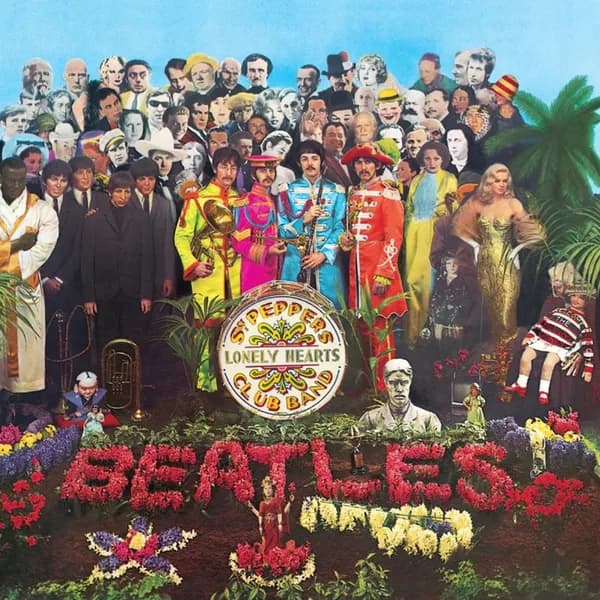
see full timeline →Three months after work on Sgt. Pepper's Lonely Hearts Club Band started, 'She's Leaving Home' and 'Getting Better' were recorded in the same days. At much the same time, 4 weeks before the session, the Penny Lane / Strawberry Fields Forever single came out. One other thing, 6 weeks later, The Sgt. Pepper cover was photographed. Elsewhere, nine days after Sgt. Pepper's Lonely Hearts Club Band's release, Hendrix opened his set with "Sgt. Pepper's".
C♯ major is the rarest key in the catalogue - 'Within You Without You' is the only Beatles song written in it.
● hover for more info● tap a tag for its page and notes
Text272 tags
The record is one of the few Beatles lyrics to deal with death ('When they pass away'), set against the motifs of social commentary and philosophy, something they had already used on 'Run for Your Life' 2 years earlier. It uses antithesis ('Within you and without you'). The title is sung in the chorus, and the writing takes after eastern philosophy and the drug culture. The language is more poem than lyric and richer in vocabulary than most.
Recurring words
Lyric shape
Cover-shared shape
Distinctive word
affiliate link - supports this wiki
Music70 tags
'Within You Without You' is a raga rock and psychedelic piece that borrows from Indian music and classical music (western string arrangement), and it is written in C♯ major. Strip out a bass guitar and drums and what is left is a melisma, the last of the 7 songs to do so, one syllable sung across several notes (hindustani-style melodic ornamentation on long syllables). It is furnished with Indian instruments, something the Beatles had already used on 'Strawberry Fields Forever' four months earlier. Partway through, the meter shifts, 4/4 (tintal) verses & chorus shift to 5/4 in instrumental break. Then, the song is unusual here, in that it is built without verses and choruses. Listen for call and response, one voice asking and the rest answering (Jawab-sawal between dilruba/sitar and violins in instrumental break). The outro departs from the rest of the song, where Harrison overdubbed laughter at the end to break the spiritual tension - a deliberate self-deprecating gesture.
affiliate link - supports this wiki
Studio10 tags
Cut over three sessions, Harrison and the Indian musicians taped the basic track at Studio 2 on March 15, 1967. Strings and additional dilruba/sitar overdubs added March 22 in Studio 1. Harrison's lead vocal and the closing laughter overdub were recorded April 3. Tape was sped up roughly a semitone (composed in C, plays in C♯). Part of it was taped in EMI Studio 1, one of only fifteen Beatles records to use that room. Harrison played the Gibson J-160E on it, his guitar. It was made with close mic'ing, first heard 4 years earlier, on 'I Saw Her Standing There'. It ends on a fade-out. This was their 131st record, and the 10th of the 25 they recorded in 1967.
affiliate link - supports this wiki
People28 tags
This is one of only 8 records with only one Beatle on it, Harrison on dilruba and swarmandal, among them 'Good Night' and 'Yesterday'. It is Harrison's, words and voice, and Neil Aspinall, road manager from 1961 and later head of Apple, takes tamboura on this one. Aspinall is also on 'Sgt. Pepper's Lonely Hearts Club Band' and 'Magical Mystery Tour'. The tabla on this one is a tintal (16-beat) and jhaptal (10-beat) cycles, and the violin here is an eight-piece string section, 8 violins.
affiliate link - supports this wiki
Info19 tags
The public first heard it when Sgt. Pepper's Lonely Hearts Club Band appeared on May 26, 1967. This song was the 10th of the 24 records the Beatles released in that year, and the 128th in the order they were recorded.
affiliate link - supports this wiki
Sources & references
Tags on this page are original analysis, transcribed and cross-checked against the fine work of others: Alan W. Pollack's “Notes on…” series, the Beatles Complete Scores (Hal Leonard), Mark Lewisohn's session histories, Ian MacDonald's Revolution in the Head, Dave Rybaczewski's Beatles Music History and Andy Babiuk's Beatles Gear for the instruments and studio equipment, and others besides - then verified by ear against the recordings. Full bibliography: Sources & thanks.
External entity links: Wikipedia · MusicBrainz recording · MusicBrainz work · Wikidata
Updated
Feedback
Got a tag idea for Within You Without You? Or think we've got it all wrong - no, no, no? Don't let it be.