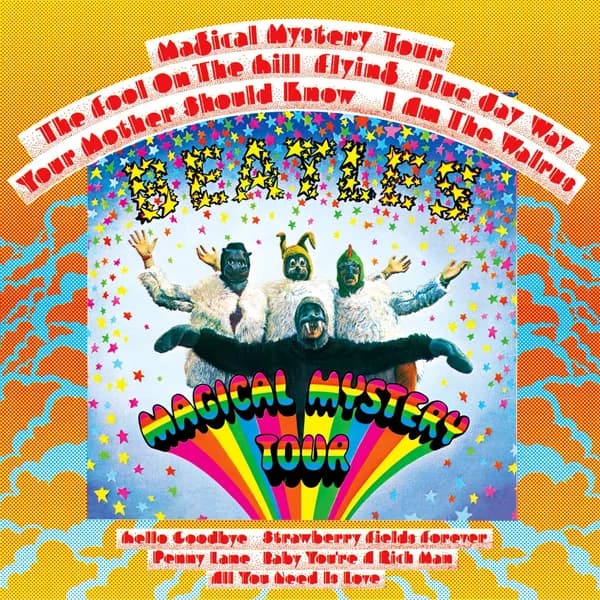
Magical Mystery Tour
“Roll up, roll up for the mystery tour”
What is unique about this song?
This record is one of three that use flanging/phasing, 'Blue Jay Way' and 'Sexy Sadie' being the others. It is the only song on Magical Mystery Tour in E major, against 38 across the catalogue.
What happened around it?
see full timeline →'Baby, You're a Rich Man' and 'All Together Now' came out of the same visits to the studio. It went down five months after work on Magical Mystery Tour started. Meanwhile, 4 weeks before the session, The Sgt. Pepper cover was photographed.
Long-time Beatles road manager Neil Aspinall. Credited on 6 Beatles recordings, including 'Yellow Submarine', 'Magical Mystery Tour', 'Sgt. Pepper's Lonely Hearts Club Band'.
● hover for more info● tap a tag for its page and notes
Text116 tags
Travel is one of its subjects (Bus/coach tour conceit), along with the motifs of smoking and surrealism, and the words are sung in a persona, a thing the Beatles returned to 23 times across 4 years. The title is also the album's and also turns up in the chorus, a thing they had done before, on 'Yellow Submarine' eleven months earlier, and the language is built on a limited vocabulary. The writing draws on music hall, and as it happens, the line "Waiting to take you away" turns up in one other Beatles song, 'Lucy in the Sky with Diamonds'.
Cover-shared shape
Distinctive word
affiliate link - supports this wiki
Music159 tags
'Magical Mystery Tour' is a rock and psychedelic song, and it is written in E major. The tune carries call and response, the backing vocals answering behind the lead (lead 'Roll up' answered by parenthetical asides), a thing the Beatles returned to 50 times across 4 years. The key moves from E major to D major in the chorus. Also, the record has a descending bass. The intro departs from the rest of the song (spoken/shouted barker intro before band enters). A small coincidence, but the chords run D → G/B → Gm/B♭ → D/A → A, the same move 'If I Fell' makes as D9 → G → Gm → D → A7.
affiliate link - supports this wiki
Studio18 tags
The record was put together at EMI Studio 3, basic tracks were cut April 25-27, 1967. The four-trumpet fanfare was overdubbed on April 27 with George Martin's score, and coach/bus sound effects were added at the November 7 mixing session. The sessions for it ran from 25 April to 7 November 1967. Lennon brought the Gibson J-160E, his guitar, which they used more in 1964 than in any other year. Double tracked vocal, flanging/phasing, leslie speaker processing and close mic'ing were used on it. This one came 14th of the 25 songs they began recording in 1967, and 135th in the whole career.
affiliate link - supports this wiki
People22 tags
McCartney wrote it and took the lead vocal. Past the usual instruments it also carries Harrison on percussion, as on 'Real Love' and 'Strawberry Fields Forever'. It features the Beatles’ own team, Neil Aspinall and Mal Evans. McCartney's piano underpins the verses and chorus.
affiliate link - supports this wiki
Info19 tags
This track was issued in the UK as a double-EP on December 8, 1967. In the US as Side 1 Track 1 of the Magical Mystery Tour LP on November 27, 1967. It sits first on Magical Mystery Tour and made the top ten at home (double-EP reached UK #2). This song was the 20th of the 24 records the Beatles released in that year, and the 138th counting from the start.
affiliate link - supports this wiki
Sources & references
Tags on this page are original analysis, transcribed and cross-checked against the fine work of others: Alan W. Pollack's “Notes on…” series, the Beatles Complete Scores (Hal Leonard), Mark Lewisohn's session histories, Ian MacDonald's Revolution in the Head, Dave Rybaczewski's Beatles Music History and Andy Babiuk's Beatles Gear for the instruments and studio equipment, and others besides - then verified by ear against the recordings. Full bibliography: Sources & thanks.
Updated
Feedback
Got a tag idea for Magical Mystery Tour? Or think we've got it all wrong - no, no, no? Don't let it be.