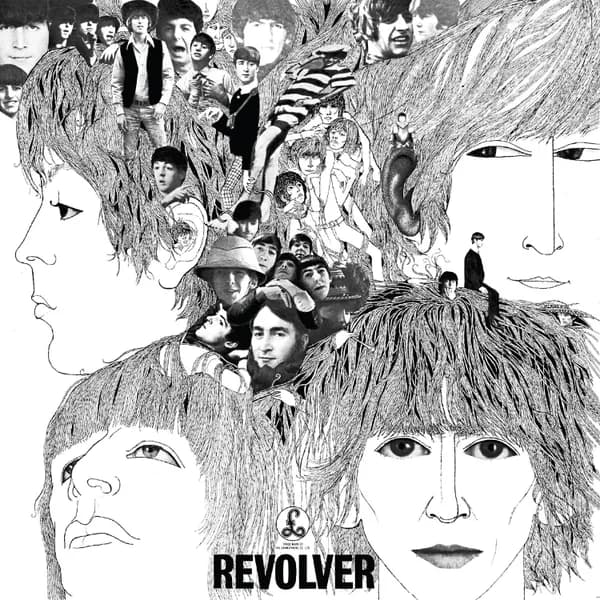
“In the town where I was born”
What is unique about this song?
The track is the only song in the catalogue that uses ocarina, and one of three songs that use echo chamber, 'A Day in the Life' and 'Paperback Writer' among them. On Revolver this is the only one with a vocal ad-lib, and also one of 24 in all. This is the first Beatles song that reaches for children's song, novelty song and music hall, and three more followed, such as 'All Together Now' and 'Good Night'.
What happened around it?
see full timeline →The band were also at work on 'I Want to Tell You' and 'Good Day Sunshine' around then. By the time they cut it, work on Revolver had been going seven weeks. As it happened, 4 days after the session, the Rain single came out. Besides that, 2 days later, George began sitar study with Ravi Shankar. Also 4 weeks earlier, Pet Sounds was released, the Beach Boys album McCartney called the greatest ever made, and a direct spur to Sgt. Pepper's.
Mick Jagger plays on 3 Beatles recordings: Baby, You're a Rich Man, Yellow Submarine, and All You Need Is Love.
● hover for more info● tap a tag for its page and notes
Text229 tags
Some of the imagery comes from nature (Sea, sun, waves, sky), along with the motifs of surrealism and storytelling. The telling is sung in a persona, a thing the Beatles returned to 47 times across 3 years. The title mentions a colour ('yellow') and also doubles as the album title, something they had reached for on 'Baby's in Black' 2 years earlier, and the language is level and neutral. The writing draws on the Goons and music hall.
Recurring words
Lyric shape
Cover-shared shape
Distinctive word
affiliate link - supports this wiki
Music104 tags
In G major at roughly 108 BPM, 'Yellow Submarine' is a children's and novelty song, and the writing shows the influence of Goons. The tune carries call and response, the backing vocals answering behind the lead (Echoed phrases in verse 4), a thing the Beatles returned to 50 times across 3 years. Then, the record features group vocals and a vocal ad-lib ('Ha-ha!', shouted commands). Worth a footnote, the chords run D → Em → C → D → G, the same move 'Any Time at All' makes as A → Bm → G → A → D.
affiliate link - supports this wiki
Studio14 tags
Basic track cut at EMI Studio 2 with John on acoustic, Paul on bass, Ringo singing live. Sound-effects and chorus overdubs followed days later with Brian Jones, Marianne Faithfull and assorted Beatles staff in attendance. McCartney played the Rickenbacker 4001S on it, his bass, and the Beatles used VariSpeed, echo chamber and ADT (double tracked vocal). It is taken out on a fade-out, a thing they returned to 46 times across 3 years. 1966 brought 19 songs, and this was the 12th of them, the 114th record of their career.
affiliate link - supports this wiki
People36 tags
McCartney and Lennon wrote it, and Starr sings lead (McCartney came up with the chorus, the melody and the title lying in bed, remembered the song as pretty much his). George Martin plays on this one as well as producing it, less common for a Beatles record, as he does on 'Slow Down' and 'And I Love Her', with tape loops filling it out, which turn up on eleven Beatles records in all. It exists to give Ringo something to sing. Listen for Marianne Faithfull on backing chorus, Brian Jones on ocarina and Mick Jagger, in as guests. Helping out from the band's own circle, Mal Evans on drums and percussion, and Neil Aspinall and Alf Bicknell on backing vocals, with Bicknell adding rattling chains. Lennon suggested combining McCartney's chorus with a verse melody of his own, and wrote it for Starr to sing. Pattie Boyd, Terry Condon and John Skinner sing behind them.
affiliate link - supports this wiki
Info27 tags
The record was issued as a double A-side with Eleanor Rigby, and it topped the UK chart for four weeks and reached #2 on the US Billboard Hot 100. It was certified gold by the RIAA (Capitol, certified 12 September 1966), and it is widely covered (the Muppets, Brian Wilson, others). Besides that it is an Ivor Novello-winning record. Its first American album was Revolver (US), three days later. You can also hear it in the film Yellow Submarine (1968). This track was the 8th of 16 released in 1966, and the 110th counting from the start.
affiliate link - supports this wiki
Sources & references
Tags on this page are original analysis, transcribed and cross-checked against the fine work of others: Alan W. Pollack's “Notes on…” series, the Beatles Complete Scores (Hal Leonard), Mark Lewisohn's session histories, Ian MacDonald's Revolution in the Head, Dave Rybaczewski's Beatles Music History and Andy Babiuk's Beatles Gear for the instruments and studio equipment, and others besides - then verified by ear against the recordings. Full bibliography: Sources & thanks.
External entity links: MusicBrainz recording
Updated
Feedback
Got a tag idea for Yellow Submarine? Or think we've got it all wrong - no, no, no? Don't let it be.