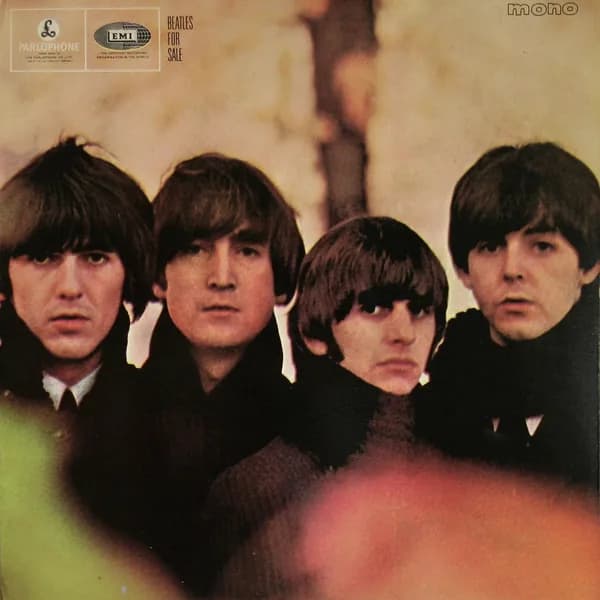
Baby's in Black
“Oh, dear, what can I do?”
What is unique about this song?
This song came from Lennon and McCartney jointly, rather than from one of them. It is the only song on Beatles For Sale in a 3/4 time signature, where the catalogue has seventeen others, first heard a year earlier, on 'A Taste of Honey'. Of the four Beatles records that have string bending, this is the earliest.
What happened around it?
see full timeline →'Mr. Moonlight' and 'I'm a Loser' were cut in the same stretch of studio time. It was the first thing the band put on tape for Beatles For Sale. In the same stretch, 13 days after the session, Slow Down came out in America, released in the UK on the Long Tall Sally EP and in the US as the B-side of the Matchbox single, reaching #25 on the Billboard Hot 100. Between the session and Beatles For Sale's release, the She's a Woman / I Feel Fine single also came out.
The Death motif first appears in the Beatles catalogue on 'Baby's in Black' (1964).
● hover for more info● tap a tag for its page and notes
Text133 tags
Death comes into the lyric (Mourning implied by black dress), which is uncommon for them, set against the motifs of relationship and loneliness. Formally it is written in the third person, which the Beatles used more in 1966 than in any other year. Worth noting, the title mentions a colour ("black"), and the language is built on a limited vocabulary. Fun fact, the line "What can I do" turns up in 3 Beatles songs, among them 'Baby It's You' and 'Got to Get You into My Life'.
Distinctive word
affiliate link - supports this wiki
Music177 tags
In A major at roughly 92 BPM, 'Baby's in Black' is a country and folk rock song with Everly Brothers influences underneath (Lennon and McCartney sang the duet into one microphone to lock the blend). The record features string bending (Harrison's solo and fills built on bends and slurs), and it has a guitar solo. It is a 12-bar blues, one of 32 in the catalogue, such as 'Chains' and 'Money (That's What I Want)'. One for the curious, the chords run D7 → E7 → A → D → A → E, which is 'You've Got to Hide Your Love Away''s F → G → C → F → C → G in another key. The meter is 12/8, not the usual four.
Chord shape
Chord literal
affiliate link - supports this wiki
Studio12 tags
Cut in 14 takes at EMI Studio 2, with John and Paul sharing a microphone face-to-face to capture the Beatles' twined harmony in a single performance. That Gibson J-160E is Lennon acoustic, in use since 1962 and heard on 66 Beatles records in all, such as 'P.S. I Love You' and 'Ask Me Why'. It was made with close mic'ing and double tracked vocal, the latter 1964 being the year it turns up most. 1964 brought 35 songs, and this was the 20th of them, the 54th record of their career.
affiliate link - supports this wiki
People12 tags
Lennon and McCartney wrote it, the two of them share the lead, as they do on 'All Together Now' and 'Thank You Girl'. It sticks to the roles they usually take, with Lennon on acoustic guitar, McCartney on bass, Harrison on electric guitar and Starr on drums. Lennon is credited with the lower harmony.
affiliate link - supports this wiki
Info13 tags
The song was released December 4, 1964, as part of Beatles For Sale. America got it eleven days later, on Beatles '65, put out by Capitol. This track was the 24th of 35 released in that year, and the 58th in the order they were recorded.
affiliate link - supports this wiki
Sources & references
Tags on this page are original analysis, transcribed and cross-checked against the fine work of others: Alan W. Pollack's “Notes on…” series, the Beatles Complete Scores (Hal Leonard), Mark Lewisohn's session histories, Ian MacDonald's Revolution in the Head, Dave Rybaczewski's Beatles Music History and Andy Babiuk's Beatles Gear for the instruments and studio equipment, and others besides - then verified by ear against the recordings. Full bibliography: Sources & thanks.
Updated
Feedback
Got a tag idea for Baby's in Black? Or think we've got it all wrong - no, no, no? Don't let it be.