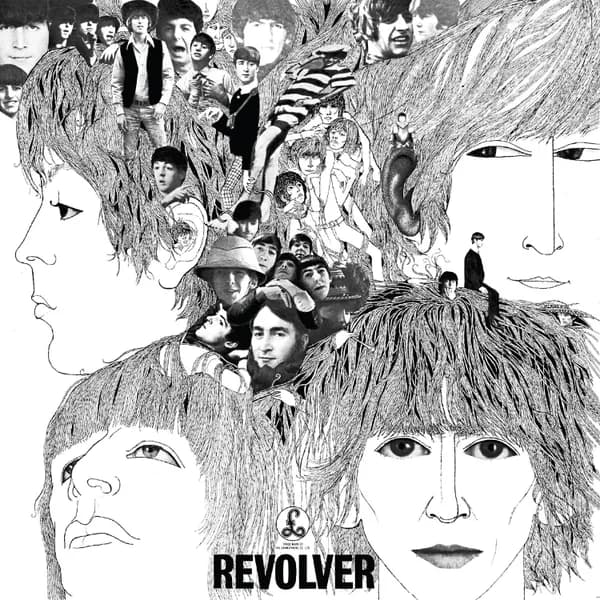
“My head is filled with things to say”
What is unique about this song?
This song shows the mark of eastern philosophy.
What happened around it?
see full timeline →Eight weeks into the making of Revolver, the band recorded 'Good Day Sunshine' and 'Yellow Submarine' in the same days. Around the same time, 2 weeks before the session, the band filmed the promo for 'Rain'. Also 3 weeks later, the Paperback Writer single came out, and topped charts in the UK, US, Australia, Canada, Ireland, Netherlands, New Zealand, Norway, Sweden and West Germany. Then 5 days later, Yesterday and Today also came out in America, a Capitol US-only compilation, June 1966. Also 4 weeks earlier, Pet Sounds was released, the Beach Boys album McCartney called the greatest ever made, and a direct spur to Sgt. Pepper's.
This song plays Bm → E7 → A → B7 and 'Maxwell's Silver Hammer' plays Em → A → D → E7: the same progression in different keys.
● hover for more info● tap a tag for its page and notes
Text223 tags
The lyric keeps measuring time ('I could wait forever, I've got time'), and it deals in the motifs of relationship and spirituality too. Formally it is confessional, and it is on more of the Beatles' 1964 records than any other year's. Curiously, the title is phrased as an instruction, and the writing draws on eastern philosophy. Interestingly, the line "I don't know why" turns up in 6 Beatles songs, among them 'Girl', 'While My Guitar Gently Weeps' and 'You Won't See Me'.
Recurring words
Lyric shape
Cover-shared shape
Distinctive word
affiliate link - supports this wiki
Music110 tags
'I Want to Tell You' moves at about 125 BPM in A major, a psychedelic and raga rock song with Indian music influences (McCartney's melismatic vocal on the outro 'I've got time'). The tune carries an ostinato (a guitar figure runs the length of the song) and an appoggiatura, a note taking its time to resolve, a habit that peaked in 1965. Also, there is a defining riff, opening A-major lead-guitar riff. As it happens, the chords run Bm → E7 → A → B7, a shape 'Maxwell's Silver Hammer' also uses, there as Em → A → D → E7.
affiliate link - supports this wiki
Studio14 tags
Cut at EMI Studio 2 on 2 June 1966 in three takes under the working title 'Laxton's Superb' (renamed 'I Don't Know' before its final title). Overdubs the following day added McCartney's piano - voiced as a dissonant E7 with added F natural that Harrison highlighted as the song's emotional pivot - plus bass, double-tracked lead vocal, three-part backing harmonies, tambourine, maracas and handclaps. McCartney recorded bass last so he could double Harrison's vocal melody, and added an Indian-style melismatic ad-lib on 'I've got time' that floats over the fade-out. Geoff Emerick engineered with Phil McDonald. That Rickenbacker 4001S is McCartney's bass. The studio work runs to double tracked vocal and leslie speaker processing, the latter a habit that peaked in 1969. 1966 brought 19 songs, and this was the 13th of them, the 115th record of their career.
affiliate link - supports this wiki
People9 tags
This one is Harrison's, written and sung. It was played the way the band normally lined up, with Lennon on rhythm guitar, McCartney on bass, Harrison on lead guitar and Starr on drums, with maracas among the instruments. The lead guitar plays opening fade-in riff, Leslie-treated, and it is on more of their 1965 records than any other year's.
affiliate link - supports this wiki
Info14 tags
The record was issued as track 9 (side 2 opener) of Revolver, released 5 August 1966. Never issued as a single. In America it arrived three days later, on Revolver (US), a Capitol record. This track was the 14th of 16 released in that year, and the 116th the Beatles ever made.
affiliate link - supports this wiki
Sources & references
Tags on this page are original analysis, transcribed and cross-checked against the fine work of others: Alan W. Pollack's “Notes on…” series, the Beatles Complete Scores (Hal Leonard), Mark Lewisohn's session histories, Ian MacDonald's Revolution in the Head, Dave Rybaczewski's Beatles Music History and Andy Babiuk's Beatles Gear for the instruments and studio equipment, and others besides - then verified by ear against the recordings. Full bibliography: Sources & thanks.
Updated
Feedback
Got a tag idea for I Want to Tell You? Or think we've got it all wrong - no, no, no? Don't let it be.