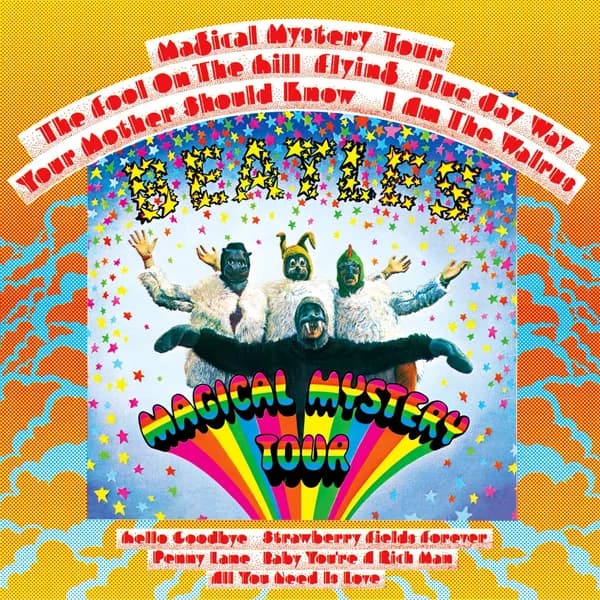
The Fool on the Hill
“But the fool on the hill sees the sun going down”
What is unique about this song?
This record is the one Beatles record that has a recorder solo, and the one song that uses penny whistle. It is also referred to in 'Glass Onion', and is one of the piano songs. This is the only Beatles record with Harrison on harmonica.
What happened around it?
see full timeline →Nine months into the making of Magical Mystery Tour, the session that made it also made 'Blue Jay Way'. The same run of sessions produced 'I Am the Walrus'. Worth noting, 13 days before the session, The Beatles met Maharishi Mahesh Yogi. While that was going on, 3 days later, Brian Epstein died.
This song is the only Beatles song to feature penny whistle.
● hover for more info● tap a tag for its page and notes
Text227 tags
Some of the imagery comes from nature (Hill, sun going down, world spinning), along with the motifs of self deprecation and character. The writing is observational, watched rather than lived. 47 songs do it, and 1964 has more of them than any other year. It uses irony (crowd calls him a fool), and the language is mixed in tone, half warm and half cold. Intentional or not, the line "The fool on the hill" turns up in one other Beatles song, 'Glass Onion'.
Recurring words
Lyric shape
Cover-shared shape
Distinctive word
affiliate link - supports this wiki
Music190 tags
'The Fool on the Hill' runs near 92 BPM in D major, and it is a psychedelic and pop piece from first bar to last. The arrangement sets woodwind alongside a descending bass (chromatic descent under chorus). Then, the key moves from D major to D minor in the chorus. The harmony takes in a min(maj7) chord, which six Beatles songs use, such as 'Cry Baby Cry' and 'Till There Was You'. Listen for an appoggiatura, a note taking its time to resolve. Curiously, the chords run D6 → Em7/D → A7 → D6 → Bm7 → Em7, a shape 'I'm a Loser' also uses, there as G → Am7 → D → G → Em → Am.
Chord shape
affiliate link - supports this wiki
Studio13 tags
This song came out of EMI Studio 3, three flautists overdubbed on Oct 20, scored by George Martin to Paul's suggestions. The bird-like coda was added as a tape loop. That Rickenbacker 4001S is McCartney's bass, in use since 1965 and heard on 86 Beatles records in all, such as 'Drive My Car' and 'Day Tripper'. They worked with the Ludwig Super Classic. The record closes with a fade-out, one of 46 songs spread over 4 years of writing. Two songs were started the day this one was, the 143rd and 144th of their career.
affiliate link - supports this wiki
People14 tags
The words and the music are both McCartney's, and the record has a role swap on it, Lennon on harp and jews harp, McCartney on recorder and penny whistle, Harrison on harmonica and Starr on finger cymbals. George Martin plays on this one as well as producing it, less common for a Beatles record, as he does on 'And I Love Her' and 'Slow Down'. In the mix, the piano is two pianos on early take.
affiliate link - supports this wiki
Info22 tags
The song came out with Magical Mystery Tour on November 27, 1967, all of it widely covered. This is the Beatles' 139th record, and the 21st of the 24 they released in that year.
affiliate link - supports this wiki
Sources & references
Tags on this page are original analysis, transcribed and cross-checked against the fine work of others: Alan W. Pollack's “Notes on…” series, the Beatles Complete Scores (Hal Leonard), Mark Lewisohn's session histories, Ian MacDonald's Revolution in the Head, Dave Rybaczewski's Beatles Music History and Andy Babiuk's Beatles Gear for the instruments and studio equipment, and others besides - then verified by ear against the recordings. Full bibliography: Sources & thanks.
Updated
Feedback
Got a tag idea for The Fool on the Hill? Or think we've got it all wrong - no, no, no? Don't let it be.