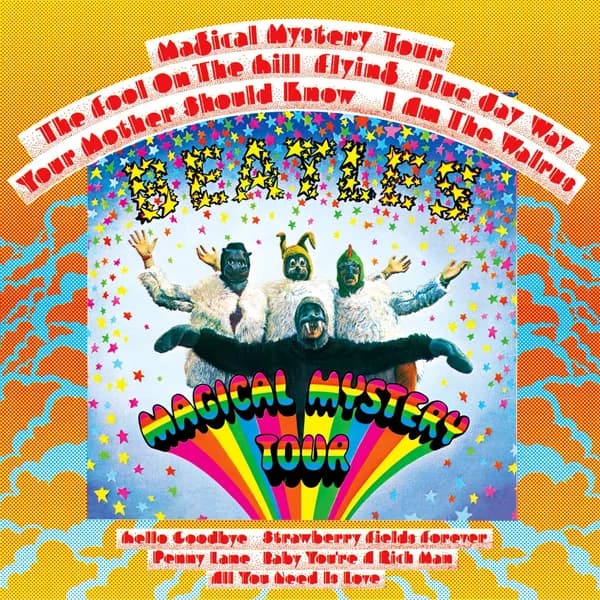
Strawberry Fields Forever
“Living is easy with eyes closed”
What is unique about this song?
This record is one of two songs that use swarmandal, alongside 'Within You Without You'. It also shows the mark of Indian music. Nowhere else does Harrison play bongos on a Beatles record, and nowhere else the timpani. This is the first Beatles song that belongs to Paul is dead, and seven more followed, such as 'A Day in the Life' and 'I Am the Walrus'.
What happened around it?
see full timeline →'When I'm Sixty-Four' and 'Penny Lane' were on the tape around then too, and it was the first song the Beatles recorded for Magical Mystery Tour. Around then, 2 weeks before the session, John met Yoko Ono. Then 6 weeks later, Tara Browne died in a car crash. In the run-up to Magical Mystery Tour's release, Lennon bought a circus poster - inspiration for 'Mr. Kite'.
Beatles roadie and personal assistant Mal Evans contributed handclaps, vocals, and noises to multiple sessions. Credited on 13 Beatles recordings, including 'You Won't See Me', 'Strawberry Fields Forever', 'You Know My Name (Look Up the Number)'.
● hover for more info● tap a tag for its page and notes
Text240 tags
The track runs on nostalgia and names real places (Childhood Liverpool setting), alongside the motifs of autobiography and home. The writing is written in stream of consciousness. 40 songs do it, and 1965 has more of them than any other year. The language is mixed in tone. In 1967, mixed tone turns up on more of the Beatles' songs than in any other year: 3 of them, 'Getting Better', 'The Fool on the Hill' and this one.
Recurring words
Cover-shared words
Lyric shape
Cover-shared shape
Distinctive word
affiliate link - supports this wiki
Music178 tags
'Strawberry Fields Forever' sets psychedelic and art rock in B♭ major and lets Indian music and classical music show through, with the bar shifting into 6/8. This is one of only 7 Beatles records in that key, the earliest of them 'Chains'. It brings in a string section, which also turns up in 'Yesterday', a year earlier. Also, it reaches for a diminished chord, one that eight of their records feature, such as 'If I Fell' and 'Michelle'. The record has prominent drum fills and drums right at the front. Listen to how the chorus arrives first, before any verse (song opens with chorus, not verse). Oddly enough, the chords run B♭ → Gm → E♭ → F → E♭, the same shape 'When I Get Home' plays as C → Am → F9 → G → F.
Chord shape
affiliate link - supports this wiki
Studio20 tags
This song came out of EMI Studio 2, built across 45 hours over five weeks. The final master joins take 7 and take 26 at the 1:00 mark via vari-speed and physical tape splicing. Lennon used the Epiphone Casino ES-230TD here, his guitar, 55 songs do it, and 1969 has more of them than any other year. They reached for the Ludwig Super Classic. Eight Beatles recordings use vocal effect in all, this among them. Reverse first turns up on a Beatles record in 1966 and peaks in 1967, when 4 of the year's songs use it. 1966 brought 19 songs, and this was the 17th of them, the 119th record of their career.
affiliate link - supports this wiki
People26 tags
This track is Lennon’s, both the writing and the voice, and the unusual credits here are McCartney on timpani and Harrison on swarmandal and timpani. Paul is off his usual instrument here, playing lead guitar (end), George on Mellotron. George Martin plays on this one as well as producing it, less common for a Beatles record, as he does on 'Everybody's Trying to Be My Baby' and 'And I Love Her'. It features the Beatles’ own team, Mal Evans on tambourine, Terry Doran on maracas and Neil Aspinall. Harrison is credited with a take 7 portion.
affiliate link - supports this wiki
Info28 tags
The song was issued as a double A-side with Penny Lane, and it reached #2 UK and #8 US, ending the band's UK No.1 streak as sales split between both tracks. It is a Grammy Hall of Fame entry. The record is one of the songs they shot a promotional film for as well (filmed at Knole Park, 30-31 January 1967). This is their 119th record, and the 1st of the 24 they released in that year.
affiliate link - supports this wiki
Sources & references
Tags on this page are original analysis, transcribed and cross-checked against the fine work of others: Alan W. Pollack's “Notes on…” series, the Beatles Complete Scores (Hal Leonard), Mark Lewisohn's session histories, Ian MacDonald's Revolution in the Head, Dave Rybaczewski's Beatles Music History and Andy Babiuk's Beatles Gear for the instruments and studio equipment, and others besides - then verified by ear against the recordings. Full bibliography: Sources & thanks.
External entity links: Wikipedia · MusicBrainz recording · MusicBrainz work · Wikidata
Updated
Feedback
Got a tag idea for Strawberry Fields Forever? Or think we've got it all wrong - no, no, no? Don't let it be.