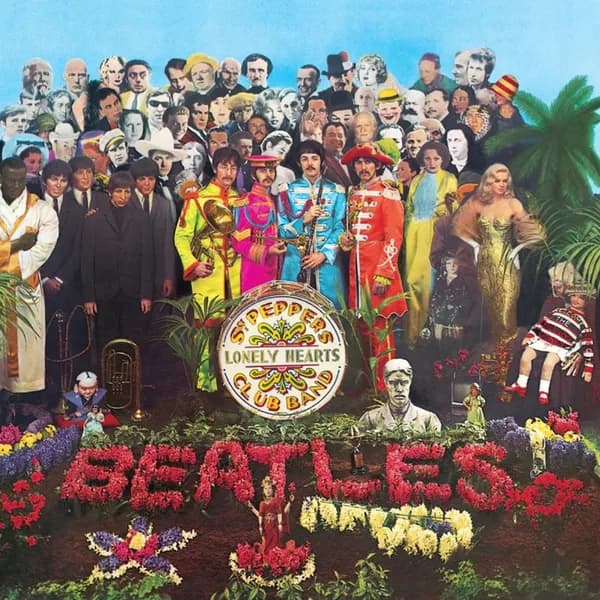
Getting Better
“It can't get no worse”
What is unique about this song?
This track stands as one of three songs that were recorded with a Burns Nu-Sonic, alongside 'Fixing a Hole' and 'Good Day Sunshine'. It also shows the mark of Indian music. This is the only track on Sgt. Pepper's Lonely Hearts Club Band with handclaps on it, and 43 others in the catalogue share it.
What happened around it?
see full timeline →'Within You Without You' and 'She's Leaving Home' were taped within a fortnight. It went down three months after work on Sgt. Pepper's Lonely Hearts Club Band started. Around the same time, 3 weeks before the session, the Penny Lane / Strawberry Fields Forever single came out. Meanwhile, 6 weeks later, The Sgt. Pepper cover was photographed. Elsewhere, shortly after Sgt. Pepper's Lonely Hearts Club Band's release, Hendrix opened his set with "Sgt. Pepper's".
'Thank You Girl' plays G → A → G → A → G → A → D and 'Getting Better' plays F → G → F → G → F → G → C: the same progression in different keys.
● hover for more info● tap a tag for its page and notes
Text259 tags
The song reaches for motifs of autobiography, nostalgia and self reflection. Formally it is confessional in tone. The same anger motif runs through 'Twist and Shout' and 'Not a Second Time', 4 years before. It uses antithesis (Paul's 'it's getting better all the time' answered by John's 'it couldn't get no worse'), 1967 being the year the Beatles used it most. The title uses the word get, and it is on more of their 1963 records than any other year's. The language is mixed in tone. In 1967, mixed tone turns up on more of their songs than in any other year: 3 of them, 'Strawberry Fields Forever', 'The Fool on the Hill' and this one.
Recurring words
Lyric shape
Cover-shared shape
Distinctive word
affiliate link - supports this wiki
Music106 tags
'Getting Better' is a rock and pop song with Indian music influences underneath (tambura drone in final verse), in C major at roughly 120 BPM. It is furnished with Indian classical instruments, 1967 being the year the Beatles used it most. Also, the tune carries call and response (backing vocals answer lead throughout), and it is on more of their 1963 records than any other year's. Worth a footnote, the chords run F → G → F → G → F → G → C, the same move 'Thank You Girl' makes as G → A → G → A → G → A → D. 'Komm, Gib Mir Deine Hand' plays D → C → D → C → D → G and 'Thank You Girl' plays A → G → A → G → A → D, the same progression in different keys, which 'Any Time at All', 'We Can Work It Out' and this one also make.
affiliate link - supports this wiki
Studio15 tags
Recorded at EMI Studio 2 over four sessions. Lennon famously took LSD by accident during the March 21 overdub and was led to the studio roof by George Martin. The session was set up with the Ludwig Super Classic drum kit and the Burns Nu-Sonic, which is on only 3 Beatles records, beside 'Fixing a Hole' and 'Good Day Sunshine'. The Beatles used ADT (double tracked vocal) on it, the latter most common in their 1964 songs. This one came 9th of the 25 songs they began recording in 1967, and 130th in the whole career.
affiliate link - supports this wiki
People15 tags
This song is McCartney's, words and voice. The record has Harrison on tamboura, as on 'Within You Without You' and 'Across the Universe', a role swap, with congas on it, which turn up on six Beatles records in all, such as 'Hello, Goodbye' and 'Penny Lane'. George Martin played electric piano, as he also did on 'You Like Me Too Much' and 'A Hard Day's Night'. This is the first Beatles session Ken Scott engineered.
affiliate link - supports this wiki
Info13 tags
This track was released May 26, 1967, as part of Sgt. Pepper's Lonely Hearts Club Band. This song was the 6th of the 24 records the Beatles released in that year, and the 124th of their career.
affiliate link - supports this wiki
Sources & references
Tags on this page are original analysis, transcribed and cross-checked against the fine work of others: Alan W. Pollack's “Notes on…” series, the Beatles Complete Scores (Hal Leonard), Mark Lewisohn's session histories, Ian MacDonald's Revolution in the Head, Dave Rybaczewski's Beatles Music History and Andy Babiuk's Beatles Gear for the instruments and studio equipment, and others besides - then verified by ear against the recordings. Full bibliography: Sources & thanks.
Updated
Feedback
Got a tag idea for Getting Better? Or think we've got it all wrong - no, no, no? Don't let it be.