Because
“Love is old, love is new”
What is unique about this song?
Among the 217, it is one of two songs that were recorded with a Baldwin harpsichord, with 'Piggies' for company. It also shows the mark of classical music. This song is where the Moog IIIp leaves the Beatles' records, after four before it, such as 'I Want You (She's So Heavy)' and 'Octopus's Garden'.
What happened around it?
see full timeline →The band were working on 'Polythene Pam' and 'She Came in Through the Bathroom Window' in the same weeks. Abbey Road was finished with this song. Meanwhile, 4 weeks after the session, Northern Songs was sold to ATV.
This song is the only Beatles song with a ♭ii° to IV section transition.
● hover for more info● tap a tag for its page and notes
Text99 tags
Some of the imagery comes from nature (World, wind, sky), along with the motifs of spirituality and love, something the Beatles had reached for on 'Anna (Go to Him)' 6 years earlier. The lyric turns to wordplay (blue - makes me cry, Wind - blows my mind). The title runs to a single word, and the language is very spare and poetic.
affiliate link - supports this wiki
Music89 tags
'Because' runs at roughly 64 BPM in C♯ minor, a baroque pop and art rock song with classical music behind it (inspired by Beethoven's Moonlight Sonata). This is one of only 3 Beatles records in that key, the earliest of them 'She's a Woman'. The tune carries an ostinato, one figure repeating underneath (Arpeggiated harpsichord/guitar figure), as it does in 'Ticket to Ride', 4 years earlier. Also, the record leaves out the kit altogether. The song is unusual here, in that it is built without verses and choruses.
affiliate link - supports this wiki
Studio14 tags
This track was put together at EMI Studio 2, recorded in 23 takes with take 16 chosen. Vocals triple-tracked on each of John, Paul, and George's parts to yield a nine-voice harmony. Harrison is on the Moog IIIp, his own modular, in Studio Two for the 5 August 1969 session, 1969 being the year he used it most. Double tracked vocal, close mic'ing and leslie speaker processing are audible on the finished record. Leslie speaker processing first turns up on a Beatles record in 1966 and peaks in 1969, when 6 of the year's songs use it. Among the 30 songs they began recording in 1969 this was the last, and the 213th of the career.
affiliate link - supports this wiki
People16 tags
Lennon wrote it, and shares the lead with McCartney and Harrison. The record has Harrison on synthesizer, as on 'Here Comes the Sun', a role swap. George Martin played electric harpsichord. It was recorded without all four, and McCartney is credited with the high register.
affiliate link - supports this wiki
Info16 tags
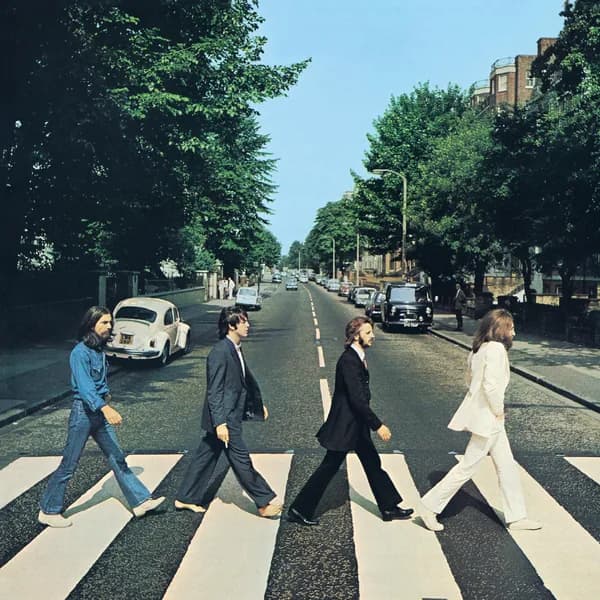
The track was never a single, and it reached the public with Abbey Road, on September 26, 1969. This song was the 15th of the 26 records the Beatles released in that year, and the 191st in the order they were recorded.
affiliate link - supports this wiki
Sources & references
Tags on this page are original analysis, transcribed and cross-checked against the fine work of others: Alan W. Pollack's “Notes on…” series, the Beatles Complete Scores (Hal Leonard), Mark Lewisohn's session histories, Ian MacDonald's Revolution in the Head, Dave Rybaczewski's Beatles Music History and Andy Babiuk's Beatles Gear for the instruments and studio equipment, and others besides - then verified by ear against the recordings. Full bibliography: Sources & thanks.
Updated
Feedback
Got a tag idea for Because? Or think we've got it all wrong - no, no, no? Don't let it be.