I Want You (She's So Heavy)
“It's driving me mad”
What is unique about this song?
The song stands as one of two that reach for proto-metal, the other being 'Helter Skelter', and one of two that use a seventh flat ninth chord, 'Till There Was You' being the other. It is the longest song the Beatles released, 7:47. This is the first Beatles song that was recorded with a Moog IIIp, and four more followed, such as 'Octopus's Garden' and 'Here Comes the Sun'.
What happened around it?
see full timeline →The band were also at work on 'Old Brown Shoe' and 'Let It Be' around then. It was the first thing the band put on tape for Abbey Road. Worth noting, 3 weeks after the session, Paul married Linda Eastman. Also 8 days later, John married Yoko Ono. Six days before Abbey Road's release, Lennon privately announced he was leaving.
Billy Preston plays on 10 Beatles recordings: Let It Be, Get Back, Something, I Want You (She's So Heavy), The Long and Winding Road, Dig a Pony, One After 909, I've Got a Feeling, Dig It, and Don't Let Me Down.
● hover for more info● tap a tag for its page and notes
Text95 tags
The track deals in the motifs of autobiography, love and hardness, and the telling is confessional in tone. The writing reaches for anaphora (successive lines begin 'I want you'), which the Beatles used more in 1968 than in any other year. The title is worth a second look, since it has carried two titles and also mentions a woman, something they had reached for on 'Norwegian Wood (This Bird Has Flown)' 4 years earlier. The language is kept to a minimum (two phrases dominate entire song) and built on a limited vocabulary. A small coincidence, but the line "I want you I want you" turns up in one other Beatles song, 'Michelle'.
affiliate link - supports this wiki
Music190 tags
'I Want You (She's So Heavy)' is a blues rock and hard rock song in D minor, a key the Beatles used 3 times in all (the earliest of them is 'The Fool on the Hill' in 1967). It moves at about 92 BPM. The tune carries an ostinato, a figure that will not go away (a bassline figure carries the instrumental stretches against the fuller verses), a thing they returned to 18 times across 6 years. Neither the key nor the meter stays put, since the key moves from D minor to A minor in the verse and the chorus, and the meter shifts under it. Also, the record has high bass notes and guitars loud and close. It has a guitar solo. Worth a footnote, the chords run G → E7/G♯ → Am7 → Dm7 → F, the same shape 'When I'm Sixty-Four' plays as G → E7 → Am → Dm → F. The Beatles first featured synthesizer here.
affiliate link - supports this wiki
Studio16 tags
Basic track cut at Trident Studios over 35 takes. Takes 9, 20 and 32 were edited together, with later overdubs including Billy Preston's Hammond organ and Lennon's Moog white-noise wind effect. The Beatles worked on it from 22 February to 20 August 1969, and the Gibson Les Paul Standard on it was Harrison's guitar. Double tracked vocal was used on it, which they used more in 1964 than in any other year. The band first used the Moog synthesizer here. 1969 brought 30 songs, and this was the 12th of them, the 195th record of their career.
affiliate link - supports this wiki
People19 tags
The words and the music are both Lennon's. There is a role swap on it, Lennon on noises and Starr on noises and wind machine, with congas, synthesizer and claves filling it out, and the claves appear on four Beatles records in all. It features a guest, Billy Preston, and the record has harmony vocals from Paul and George. You can hear a wind machine and Moog white noise on it.
affiliate link - supports this wiki
Info17 tags
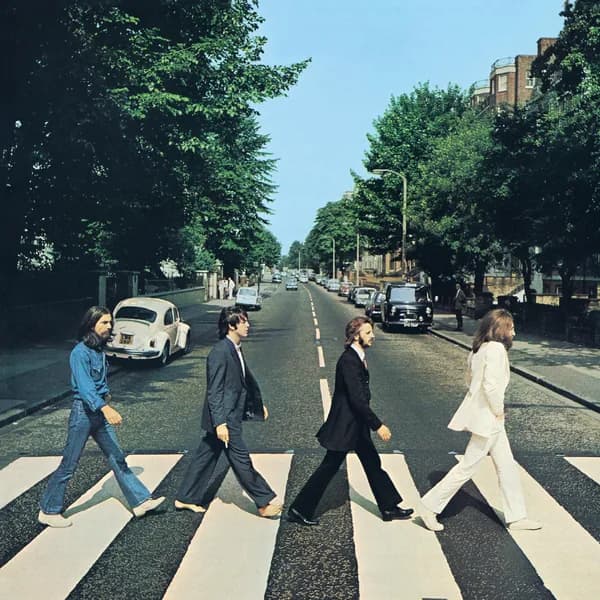
The song was released September 26, 1969, as part of Abbey Road. This song was the 13th of the 26 records the Beatles released in that year, and the 189th counting from the start.
affiliate link - supports this wiki
Sources & references
Tags on this page are original analysis, transcribed and cross-checked against the fine work of others: Alan W. Pollack's “Notes on…” series, the Beatles Complete Scores (Hal Leonard), Mark Lewisohn's session histories, Ian MacDonald's Revolution in the Head, Dave Rybaczewski's Beatles Music History and Andy Babiuk's Beatles Gear for the instruments and studio equipment, and others besides - then verified by ear against the recordings. Full bibliography: Sources & thanks.
Updated
Feedback
Got a tag idea for I Want You (She's So Heavy)? Or think we've got it all wrong - no, no, no? Don't let it be.