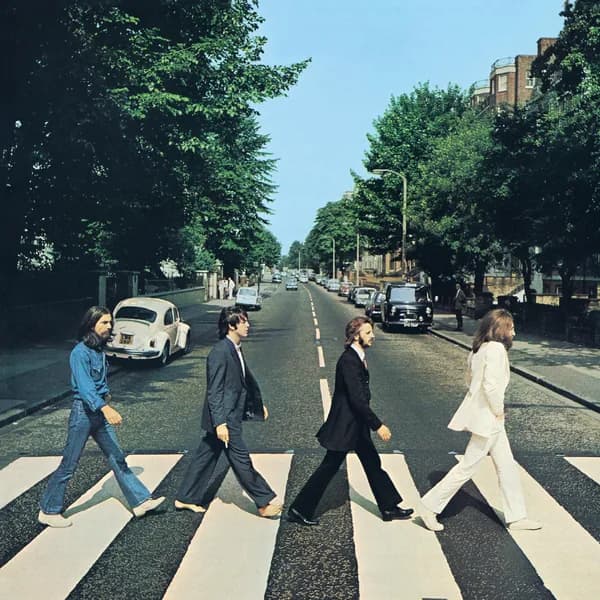
Something
“Something in the way she moves”
What is unique about this song?
The track stands as one of three songs that show the mark of Ray Charles, 'I Feel Fine' and 'The Long and Winding Road' among them, and one of the love songs, as well as one of the ones handed to other acts. It also welcomed a guest to the session (Billy Preston on Hammond).
What happened around it?
see full timeline →Eight weeks after work on Abbey Road started, 'The Ballad of John and Yoko' and 'Oh! Darling' were recorded in the same days. Also 3 weeks before the session, Allen Klein was appointed manager. Also 2 weeks later, the Don't Let Me Down single came out, issued as the B-side of 'Get Back', the A-side topping the UK and US charts. The B-side reached #35 on the US Billboard Hot 100. In the background, 3 weeks later, Don't Let Me Down also came out in America. Not long before Abbey Road's release, Lennon privately announced he was leaving.
Billy Preston plays on 10 Beatles recordings: Let It Be, Get Back, Something, I Want You (She's So Heavy), The Long and Winding Road, Dig a Pony, One After 909, I've Got a Feeling, Dig It, and Don't Let Me Down.
● hover for more info● tap a tag for its page and notes
Text194 tags
The words touch on the motifs of self reflection, women and love, and the lyric turns to anaphora. Interestingly, the title is just the one word, which the Beatles had last done on 'Matchbox' 5 years earlier, and it reaches once for triple rhyme ("grow/know/show"). For anyone keeping count, the line "All I have to do is" turns up in one other Beatles song, 'Act Naturally'.
Lyric shape
Cover-shared shape
Distinctive word
affiliate link - supports this wiki
Music249 tags
In C major at roughly 66 BPM, 'Something' is a ballad and rock song, with Ray Charles and Indian music influences (gamaks in guitar solo). It brings in string players, alongside a melodic bass and a bass part that ignores the chords. Then, the harmony takes in a min(maj7) chord, heard on six Beatles records in all, such as 'Cry Baby Cry' and 'Till There Was You'. Listen to the shape and you find it is built without verses and choruses, and the key moves from C major to A major in the bridge. Listen for musical quotation, a borrowed phrase, and it features a guitar riff. Fun fact, the chords run F♯m → A/E → D → G → A, a shape 'For No One' also uses, there as G♯m → B/F♯ → E → A → B.
Chord shape
Chord literal
affiliate link - supports this wiki
Studio15 tags
Initial April 16 attempt was scrapped. The band rebuilt the song across EMI and Olympic sessions with Billy Preston, the guest musician, on Hammond, two reduction mixes trimming an eight-minute jam coda before George Martin's strings were overdubbed. Work on it ran from 16 April to 15 August 1969, and it is one of only six Beatles records cut at Olympic Sound Studios. The Rickenbacker 4001S on it was McCartney's bass, and they reached for the Ludwig Hollywood Maple, Starr's own kit since 1968. Leslie speaker processing was used in making the record, which they had last done on 'Magical Mystery Tour' 2 years earlier. This one came 15th of the 30 songs they recorded in 1969, and 198th in the whole career.
affiliate link - supports this wiki
People20 tags
The song was written and sung by Harrison. George Martin plays on this one as well as producing it, less common for a Beatles record, as he does on 'Mother Nature's Son' and 'And I Love Her'. Fun fact, Billy Preston on organ turns up on this one. Behind the band sit violin, viola and cello, and the piano is mostly mixed out.
affiliate link - supports this wiki
Info25 tags
The track was issued as a double A-side with Come Together, and it topped the US Billboard Hot 100 and reached #4 in the UK - the Beatles' 18th US #1, surpassing Elvis Presley's record. It stands as an Ivor Novello-winning record as well. It is also one of the songs they made a promotional film for (filmed late October 1969). The Beatles have 4 songs written by a Beatle for another artist to record, and they are 'I Wanna Be Your Man', 'I Call Your Name', 'Come Together' and this one. This song was the 9th of the 26 records they released in that year, and the 185th of their career.
affiliate link - supports this wiki
Sources & references
Tags on this page are original analysis, transcribed and cross-checked against the fine work of others: Alan W. Pollack's “Notes on…” series, the Beatles Complete Scores (Hal Leonard), Mark Lewisohn's session histories, Ian MacDonald's Revolution in the Head, Dave Rybaczewski's Beatles Music History and Andy Babiuk's Beatles Gear for the instruments and studio equipment, and others besides - then verified by ear against the recordings. Full bibliography: Sources & thanks.
External entity links: Wikipedia · MusicBrainz recording · MusicBrainz work · Wikidata
Updated
Feedback
Got a tag idea for Something? Or think we've got it all wrong - no, no, no? Don't let it be.