Her Majesty
“Her Majesty's a pretty nice girl”
What is unique about this song?
This track has McCartney as its only Beatle, and it was cut as a live recording. It is the shortest song in the catalogue, 0:23.
What happened around it?
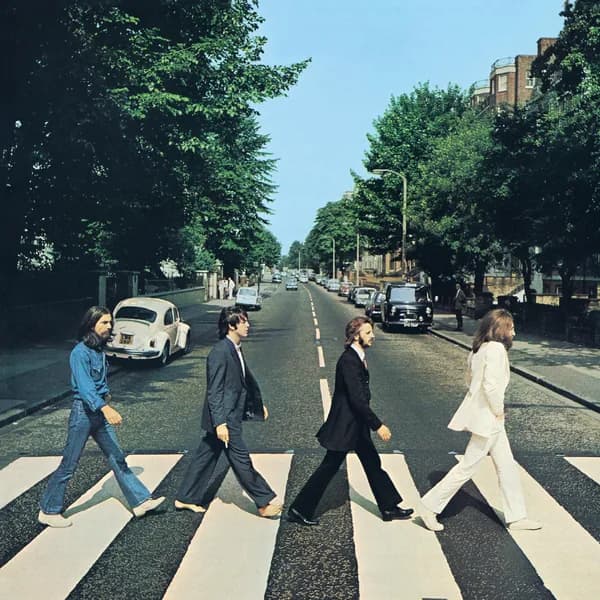
see full timeline →'Golden Slumbers' and 'Carry That Weight' came off the same tape, and it was taped four months into the making of Abbey Road. In the run-up to Abbey Road's release, Lennon privately announced he was leaving.
At 0:23, 'Her Majesty' is the shortest song the Beatles released.
● hover for more info● tap a tag for its page and notes
Text126 tags
Real people are named in it (Queen Elizabeth II), and the lyric deals in the motifs of women and love. It is a vignette rather than a narrative. 27 songs do it, and 1968 has more of them than any other year. The writing reaches for anaphora (successive lines open 'Her Majesty's a pretty nice girl'), most at home in the Beatles' 1968 writing. An extrametrical rhyme arrives once, "mine oh yeah / wine". A curiosity, the title refers to a woman.
Lyric shape
Cover-shared shape
Distinctive word
affiliate link - supports this wiki
Music170 tags
'Her Majesty' is a music hall piece, written in D major and taken at about 100 BPM. In the absence of a bass part and a kit behind it, what carries it is fingerpicking rather than strumming. It reaches for a sus2 chord, one that four of the Beatles' records feature, such as 'Penny Lane' and 'A Day in the Life'. It does without the usual verse and chorus, which is unusual for them. Oddly enough, the chords run D7 → G → Gm → D → B7 → E7 → A6 → D, a shape 'When I'm Sixty-Four' also uses, there as C7 → F → Fm → C → A7 → D7 → G7 → C. On a smaller note, 'Till There Was You' plays B♭ → B♭m → F → D7 and 'When I'm Sixty-Four' plays F → Fm → C → A7: the same progression in different keys, which 'Honey Pie', 'I Will' and this one also make.
Chord shape
Chord literal
affiliate link - supports this wiki
Studio7 tags
McCartney cut three takes alone at EMI. Tape operator John Kurlander, the assistant engineer, preserved the dropped take per a standing order never to discard Beatles material, splicing it after The End with 14 seconds of leader tape. McCartney recorded the song solo on his acoustic. Three songs came off that day's tapes, the 202nd to the 204th of the career.
affiliate link - supports this wiki
People9 tags
McCartney wrote the song and sang it himself, and there is a role swap on it, McCartney on acoustic guitar. It was cut without the whole band (McCartney recorded it alone), most at home in their 1965 writing.
affiliate link - supports this wiki
Info16 tags
The track reached the public on September 26, 1969, with Abbey Road, and was never a single. On the record it sits last on the album. This track was the 24th of 26 released in that year, and the 200th in the order the Beatles were recorded.
affiliate link - supports this wiki
Sources & references
Tags on this page are original analysis, transcribed and cross-checked against the fine work of others: Alan W. Pollack's “Notes on…” series, the Beatles Complete Scores (Hal Leonard), Mark Lewisohn's session histories, Ian MacDonald's Revolution in the Head, Dave Rybaczewski's Beatles Music History and Andy Babiuk's Beatles Gear for the instruments and studio equipment, and others besides - then verified by ear against the recordings. Full bibliography: Sources & thanks.
Updated
Feedback
Got a tag idea for Her Majesty? Or think we've got it all wrong - no, no, no? Don't let it be.